Why Skills Need Space Between Attempts
Why skills need space between attempts: use pauses to notice what you can recall, spot a specific learning gap and return to practice with fresh attention.
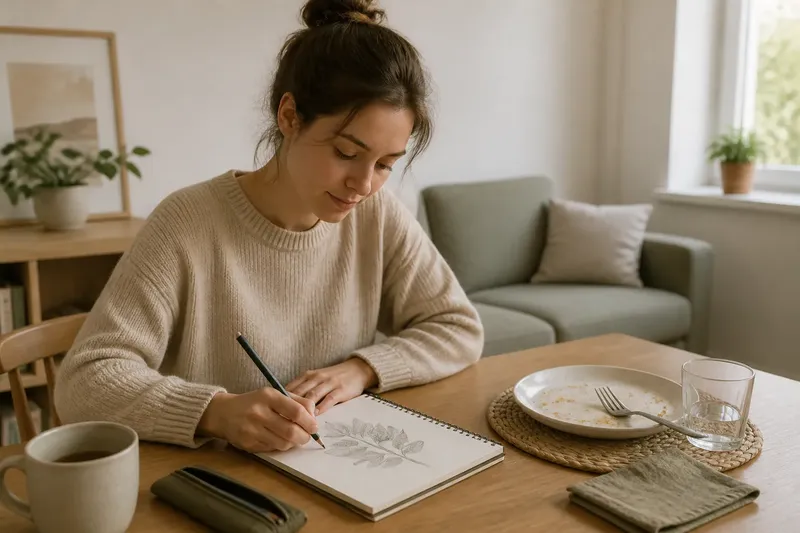
You close your sketchbook after wrestling with a sleeve, then catch yourself replaying its folds while the kettle boils. A pause can make the next drawing feel different: not easier by magic, but easier to inspect with fresh eyes. That is why skills need space between attempts.
Time away is not a substitute for practice. It gives you another kind of opportunity: to see what you can recall, notice where an attempt falters and choose what to examine when you return. The aim is not to plan every minute between sessions, but to let practice and ordinary life remain distinct.
Attention needs contrast
While you work, attention settles around the task. That is useful when you are sounding out a difficult piano phrase or following a new algebraic method. But repeated concentration can become tunnel vision: you keep looking at the same passage without noticing its details.
Doing something unrelated for a while changes what you are asking of yourself. Make lunch, walk round the block or talk to someone about something else. None of these activities has to be a secret learning technique; they simply give you a break from the same demand.
When you return, begin by observing. Listen to the piano phrase before playing it, or reread the algebra question and identify what it asks. You may spot a detail that was hidden by the momentum of repetition.
Let the first attempt back be an observation, not a verdict.
Feedback beats autopilot
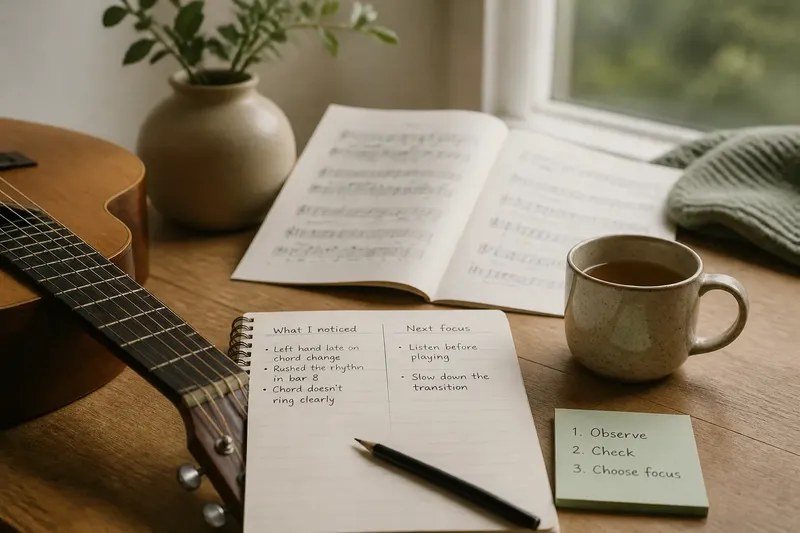
Repeating a movement or answer is useful only if you can attend to what happens. If your fingers move through a guitar chord change while your mind is elsewhere, you may not notice whether the transition is clean. More effort alone will not tell you what to adjust.
A pause can help you approach the next attempt as a new chance to listen or look. Ask a precise question: did the left hand arrive late, did the chord ring clearly, or did the written explanation skip a step? A specific observation gives you more to work with than “I need to practise harder.”
Say you are learning French past-tense forms and keep choosing the wrong auxiliary verb. You stop after a focused practice session, take a walk without rehearsing the rules, then return and check each sentence against a trusted grammar reference. If the same kind of sentence keeps tripping you up, your next practice can focus on that distinction; if the errors vary, review the rule before narrowing the exercise. The pause has not supplied the answer, but it has made the next question easier to see.
When repetition stops giving you information, change what you are listening for.
Recall reveals gaps
A solution can feel familiar when it is right in front of you. Returning later asks something different: can you retrieve the idea, movement or sequence without copying it? This makes the attempt informative, even when the answer does not come straight away.
Someone learning plant identification might name a leaf before opening a field guide. A learner practising a speech might try the next section without reading from a screen. In either case, the point is to find out what is available from memory, not to treat a lapse as failure.
Keep the check small: one question, a short passage or a single movement. Then compare your attempt with a reliable reference or the model you are learning from. If you cannot retrieve it, review that part and try again another time.
Use recall to choose what to review, not to judge your ability.
Fatigue clouds judgement
When you are tired, the same exercise can become a different task. A musician may begin by attending to rhythm and end up forcing a passage through. A reader may turn pages without being able to explain the point of the section.
That is a poor moment to draw sweeping conclusions about your skill. A clumsy late attempt may reflect fatigue rather than a change in what you can do. Notice ordinary signals such as rereading the same line, tensing your shoulders, repeating an error you can already identify, or losing sight of the exercise’s purpose. You can stop, switch to something lighter or finish for the day.
These signs are prompts for a sensible choice, not a rigid rulebook.
Unclaimed time matters
Waiting for a bus can become a flashcard session; cooking can become a rehearsal. Short reviews may be useful when you choose them, but there is no need to turn every empty moment into another performance.
Unstructured time has ordinary pleasures: noticing the street, chatting with a friend or letting your thoughts wander. It can also help mark a boundary around practice. A hobby or lesson need not be followed by silence; read for pleasure or listen to music if that is what you want. The distinction is whether you chose the activity or automatically turned spare time into another assignment.
Let some moments belong to whatever is happening around you.
What should pauses change?
How long should I pause between sessions?
There is no single interval for every learner or skill. Return when you can give the task some attention, and adjust if you still feel mentally crowded or cannot recall enough to make a useful attempt.
Should I rehearse during a break?
You do not have to practise deliberately for a pause to be worthwhile. If a question occurs to you, note it briefly if helpful, then let the break remain a break.
Can a short practice session help?
Yes, a short session can give you a chance to review one part of a skill. The useful test is whether you can tell what you are practising and what you noticed, not whether you made the session longer.
What if returning feels difficult?
Set out the instrument or open the relevant page, then make one modest attempt. If you remain reluctant, you can stop or choose a lighter task rather than treating the pause as a promise you have broken.
Keep practice distinct
Skills need space between attempts because returning gives you a different view of the work: you can test recall, hear an error more clearly or notice that fatigue has taken over. A pause does not need to produce an insight every time. Sometimes its useful result is simply that you stopped before practice became a blur.
For your next session, choose an activity you can actually attend to, such as checking one chord change or recalling one idea from a page. When you have finished, let the next part of the day be something other than a disguised continuation of that exercise. That boundary helps keep learning both deliberate and human.