A Midweek Review for a Plan That Drifted
A midweek review helps you spot what changed, keep useful progress and choose one realistic adjustment for the days still ahead.
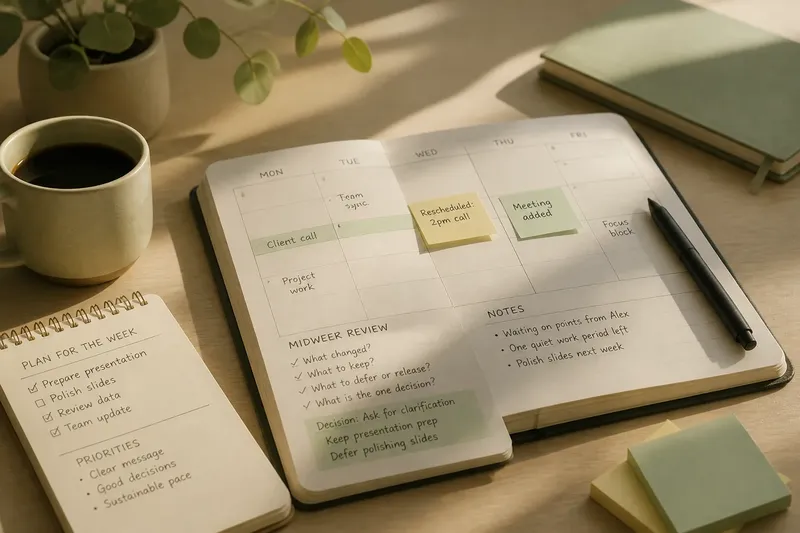
On Wednesday afternoon, Monday’s neat plan is buried under a rescheduled appointment and a note about a task that grew larger than expected. A midweek review of a plan that drifted is a way to take stock without turning the week into a trial. The aim is to decide what deserves attention now, given the week you actually have.
Set aside a short pause with your calendar and task list. Look for changes in commitments, priorities and available energy, then revise the plan to match. The review is complete when you can explain what changed and what you are choosing to do about it.
Read the week
Compare Monday’s plan with the week so far. A calendar, paper planner or phone notes will do. Notice which commitments happened, which changed, and which remain uncertain. Keep the language factual: “The appointment moved to Thursday” is more useful than “Everything went wrong”.
Look for the source of the drift. An unexpected request calls for a different response from a task that turned out to need more coordination than you expected. Record the distinction without judging it. That gives you a clearer basis for deciding what to keep.
Separate what you know from what you are guessing. If you are unsure whether a colleague still needs a document this week, mark that uncertainty instead of quietly treating the deadline as fixed.
Choose a review lens
Use the lens that fits the main pressure on the week. There is no need to apply every method; the point is to make one sensible decision, not to create a second planning project.
Keep and release
When new demands have crowded the calendar, sort remaining commitments into three groups: keep this week, defer to a later date, or release. For each item, consider what would be affected by waiting and whether it still serves a current priority. A deferred item needs an honest future date; otherwise it may simply linger as an open loop.
Notice what changed
When the week feels unproductive, compare its original conditions with the ones you encountered. Perhaps several short appointments broke up a planned stretch of concentration, or a decision from someone else is still pending. This lens helps distinguish a changed situation from a mistaken assumption without turning either into a judgement about your character.
Check available capacity
When the remaining days are already crowded, look at the commitments that cannot move before adding anything else. Include routine responsibilities, travel between appointments and the breathing room needed after demanding work. If the revised plan only works when nothing unexpected happens, it is still too ambitious.
For example, imagine you planned to prepare a presentation, but a meeting was added and the notes still need sorting. Your remaining calendar has one quiet work period, and a colleague is waiting to confirm which points matter most. You decide to ask for that clarification, keep presentation preparation on the plan, and defer polishing the slides. The observable result is a narrower task with fewer unknowns; the trade-off is that visual refinements wait.
Make one decision
Choose one adjustment that addresses the main source of drift. You might reduce the scope of a commitment, move it to a quieter part of the week, ask someone to clarify an expectation, or remove an item that no longer matters. Make the decision visible in your calendar or task list so that the revised plan reflects it.
Check the other commitments before you add work. If moving one task would make the day crowded, defer or release something else rather than pretending both will fit. A revised plan is useful when it shows the trade-off as well as the choice.
Keep the change focused. If you alter several priorities and arrangements at once, it becomes harder to tell whether the new plan fits the week. One clear decision is easier to review later.
Questions readers ask?
When should I review a drifting plan?
Choose a natural pause when you can look at the calendar and make a decision without rushing. Midweek is a useful moment if enough has changed to make the original plan unreliable.
What if I cannot tell what matters most?
Check which commitment has the clearest consequence if it waits, and ask for clarification where another person’s expectations are involved. If the consequences remain unclear, avoid treating an assumption as a firm priority.
Should I carry every unfinished task forward?
No. Decide whether each item still belongs in the coming days, needs a deliberate later date, or can be released. This keeps an old list from quietly becoming a permanent obligation.
What if the plan drifts again?
Notice what changed between the revised plan and the week that followed. If outside demands repeatedly interrupt the schedule, leave more open space in future plans; if priorities shift, revisit which commitments still deserve a place.
Record the decision
Write down the change and the reason for it in a place you will see again, such as the calendar entry or the relevant task. A note like “Slides deferred until the main points are confirmed” records both the choice and its condition. It is not a promise that the rest of the week will go smoothly; it is a record you can use if circumstances change again.
Before closing your midweek review, check that the remaining commitments still fit the calendar and that deferred items have not been mistaken for current work. The useful question is not whether the week matches Monday’s plan, but whether today’s plan reflects what you now know.